Pricing & Production Policy
Transparent Rates, Detailed Terms, and Clear Expectations for Every Scanning Project.











Fuel Your Ambition, Ignite Your Dreams!
Success begins with a strong will and consistent effort. Every small step brings you closer to your goals. Believe in yourself, embrace challenges, and never give up. Start today and turn your dreams into reality!




















Fuel Your AMBITION, Ignite Your Dreams!
Success begins with a strong will and consistent effort. Every small step brings you closer to your goals. Believe in yourself, embrace challenges, and never give up. Start today and turn your dreams into reality!

Pricing, Production & Terms
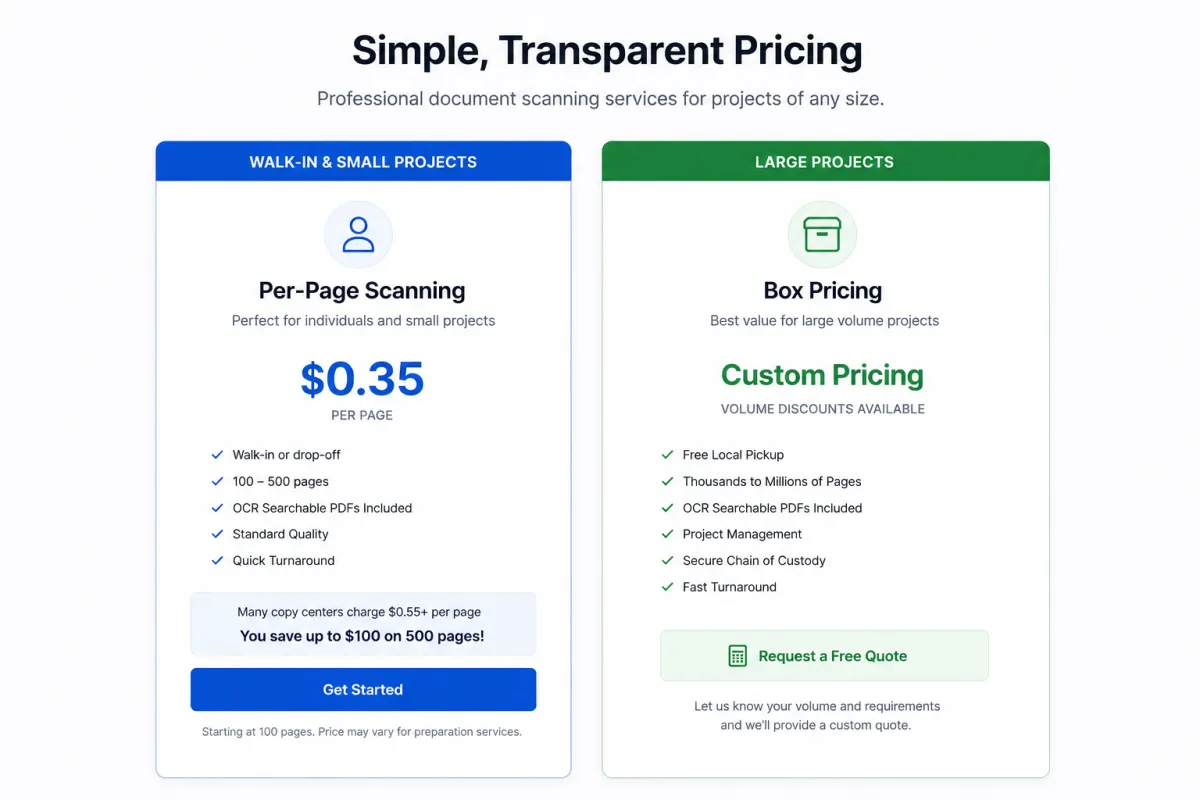
Effective Date: 01-01-2025
USA Imaging, Inc. provides high-quality document and photo scanning services using standardized procedures and transparent pricing to ensure fairness, accuracy, and efficiency. This policy outlines our box-based pricing model, applicable surcharges, document indexing standards, delivery fees, file access options, and post-project storage terms.





Standard Box Dimensions
All pricing is based on a standard storage box size of 10" x 12" x 15".
Box-Based Surcharges
Certain box conditions and contents require additional handling and are subject to surcharges as follows:
Oversized Box Surcharge
Any box that exceeds the standard size upon pickup will incur a 50% surcharge on the estimated price.Mixed Content Surcharge (50% Office Docs / 50% Receipts)
Boxes containing a 50/50 mix of office documents and receipts will incur a 50% surcharge due to additional prep work required.Receipt-Only Box Surcharge
Boxes containing only receipts are subject to a 100% surcharge (i.e., double the base price) due to the time-intensive preparation involved.Receipts require extensive handling, such as staple removal, flattening, and sorting due to their varied sizes, fragility, fading, and frequent discoloration.
Debris and Dust Cleaning Surcharge
If a box requires vacuuming or cleaning due to dust, cobwebs, or dead insects (e.g., spiders), a $45 per box charge will be added for contamination management.Toxic Hazard Surcharge (Rat Droppings)
If rat droppings or other biohazards are found in a box, a $100 per box surcharge will be added to accommodate toxic hazard intervention and protective cleaning protocols.Mold and Mildew Surcharge
If mold or mildew is detected inside any box or on its contents, a $100 per box surcharge will be assessed to cover safety precautions and containment measures.Wet or Moist Paper Surcharge
If documents are found to be wet or damp, requiring them to be aired out, separated, and dried, a $100 per box surcharge will apply due to the additional labor and equipment needed to stabilize the materials for scanning.
Handling of Binders, Folders & Sleeves
All binders, folders, plastic sleeves, and other document storage materials are discarded after scanning.
We do not recycle, return, or store these items unless otherwise requested in advance.
If you require these materials to be returned, they will be delivered back to you for a standard delivery fee of $75 per trip.
Document Indexing
USA Imaging performs folder-level indexing as part of every project.
Folder names are used to label corresponding digital files.
If documents are submitted loose or without an established folder/naming system, they will be scanned and labeled as “Miscellaneous”, to be renamed by the client after delivery.
Additional indexing or renaming services are available upon request and may incur additional charges.
Digital File Access & Remote Repository
USA Imaging offers access to your scanned documents through our secure remote file repository, available at no additional charge.
Files remain available for online access unless you request digital shredding.
If digital shredding is requested, your account and all digital documents will be permanently deleted and no longer accessible through the repository.
USB Media Charges
If digital files are to be delivered via USB or hard drive:
USB drives range from $10 to $55, depending on size and storage capacity.
If an external hard drive is required, pricing will range from $200 to $500, depending on the brand and specifications requested.
Delivery Charges
A delivery fee applies if materials (originals or USBs) need to be returned or delivered to the client:
Flat Rate Delivery Fee: $75.00 per trip
Post-Scanning Storage Policy
All boxes are stored at USA Imaging’s secure, climate-controlled facility for 30 days after scanning completion.
If no written authorization to shred is received within 30 days, a $2.50 per box, per day storage fee will be assessed.
Long-term storage agreements are available upon request. Monthly rates will be provided based on project volume.
Client Agreement
By proceeding with services from USA Imaging, Inc., the client acknowledges and agrees to this pricing structure, including all applicable surcharges, file handling terms, indexing rules, storage policies, and repository access conditions. All charges will be reflected in the final invoice and are payable by the client.
Learn More About Our Services
USA Imaging offers convenient photo scanning services to allows you to re-live and share your history effortlessly.
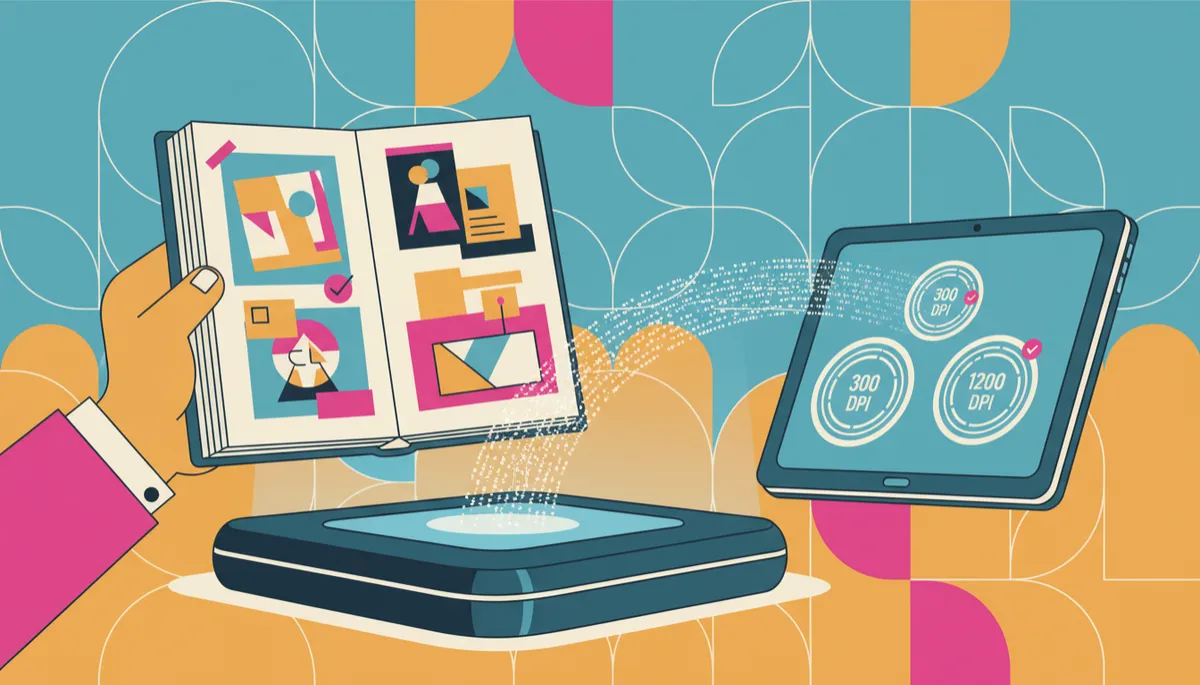
Best DPI for Scanning Scrapbooks: 300, 600, or 1200?
Scrapbook Scanning, DPI Scanning, Best Scanning Resolution
300, 600 or 1200 DPI: What’s Best for Scanning Scrapbooks?
If you’re ready to preserve your cherished scrapbooks, you’ve probably run into a confusing question: DPI Scanning—should you choose 300, 600, or even 1200 DPI? As San Diego’s long‑time document and scrapbook scanning specialists, USA IMAGING, Inc. is here to walk you through the best scanning resolution for your memories in a clear, friendly way.
What Does DPI Mean, Really?
Let’s start simple. DPI stands for “dots per inch.” In everyday terms, it’s a measure of how much detail your scanner captures. A higher DPI means more tiny “dots” of information per inch of your scrapbook page. More dots = more detail, but also larger file sizes and longer scan times.
When you’re thinking about DPI scanning for scrapbooks, you’re really balancing three things:
How sharp and detailed you want the digital images to look
How you plan to use or share those images (print, web, slideshow, etc.)
How much storage space you’re comfortable using
300 DPI: Great for Everyday Viewing and Sharing
For many families, 300 DPI is a solid, practical choice for scrapbook scanning. At 300 DPI, your pages will look clear and crisp on screens and in standard reprints close to the original size. It’s also the long‑standing standard for good-quality printing.
Benefits of 300 DPI scanning:
Ideal for viewing on phones, tablets, and computers without huge file sizes
Works well for photo books and reprints at similar sizes to the original scrapbook
Faster scanning and easier online sharing with family members
At USA IMAGING, Inc., we often recommend 300 DPI when the goal is simple: preserve the layout, keep the colors true, and make it easy for everyone in the family to enjoy the pages digitally.
600 DPI: The Sweet Spot for Detailed Scrapbooks
If your scrapbooks include tiny handwriting, intricate stickers, or small photos you may want to crop and reprint later, 600 DPI is often the best scanning resolution. It captures noticeably more detail than 300 DPI, which can make a real difference for older, faded, or handwritten elements.
Why so many scrapbookers love 600 DPI scanning:
Better readability for cursive notes, dates, and captions
More flexibility for enlarging individual photos from a page without losing quality
A nice balance between file size and high-quality detail
💡 Friendly Tip: For most scrapbook scanning projects we handle at USA IMAGING, Inc., 600 DPI is the “just right” choice—especially if the scrapbooks are older or especially meaningful.
1200 DPI: When Is Ultra‑High Resolution Worth It?
1200 DPI sounds impressive, and it can be useful—but it’s not always necessary. At this level, you’re capturing extremely fine detail that may not be visible to the naked eye. That’s helpful in specific situations, but it also creates very large files that can be slower to open, share, and store.
Consider 1200 DPI scanning if:
You plan to make large poster‑size prints from small photos in the scrapbook
Your scrapbook includes tiny, detailed artwork or very small text you want to preserve perfectly
You’re creating an archival master copy and are comfortable managing large file sizes
For most families in San Diego County, 1200 DPI is more than they need for everyday viewing and sharing. That’s why our team at USA IMAGING, Inc. usually recommends it only for select pages or special elements, rather than an entire project.
Choosing the Best Scanning Resolution for Your Scrapbooks
Still unsure which DPI is right for you? Here’s a quick way to decide:
Mostly digital viewing and simple reprints: 300 DPI is usually enough.
Detailed pages, older albums, or future enlargements: 600 DPI is often the best scanning resolution.
Special projects or large posters: Use 1200 DPI for select images.
📌 Key Takeaway: More DPI is not always better. The best DPI scanning choice is the one that fits how you’ll actually use your digital scrapbook files.
Why Work with a Professional Scanning Service?
Scrapbooks are often one‑of‑a‑kind. Pages may be bulky, fragile, or filled with layered items like ribbons, envelopes, and keepsakes. At USA IMAGING, Inc., we use professional‑grade scanners and careful handling techniques to capture these pages safely and accurately, without flattening or damaging delicate elements.
Beyond choosing the right DPI, we also help with:
Color correction and gentle enhancement for faded photos
File naming and organization so pages are easy to find and share
Secure handling and confidentiality, backed by decades of experience and compliance with strict standards like HIPAA for sensitive documents
Ready to Preserve Your Scrapbooks?
Whether you choose 300, 600, or 1200 DPI, the most important step is simply getting your scrapbooks safely digitized so they can be enjoyed for generations. If you’re in San Diego County or the surrounding areas, USA IMAGING, Inc. would be honored to help protect your family’s story with professional, secure scrapbook scanning tailored to your needs.
Have questions about DPI scanning or the best scanning resolution for your specific albums? Our friendly team is happy to talk through options, show sample results, and recommend the right approach for your project and budget.
Ready to get started? Contact USA IMAGING, Inc. today to Get a Quote and take the first step toward preserving your scrapbooks safely and beautifully in digital form.

Better Scans. Better Quality. Better Service.
San Diego Document Scanning Experts Since 1991

© 2023 by USA IMAGING, Inc.. All rights Reserved. Powered by: Top Run Marketing.
Facebook
Instagram
LinkedIn
Youtube